Frequently asked questions
Prime Health is here to keep you well and help you make the right health decisions so we've gathered a list of frequently asked questions about our centres and the wide range of services we provide.
Multiparametric MRI (mpMRI) is a comprehensive MRI scan of the prostate gland and pelvis which is commonly used to investigate men with a raised PSA. It involves an injection of contrast (see below) and typically takes around an hour to perform.Biparametric MRI (bpMRI) is a shorter MRI scan which recent research suggests can be used to detect prostate cancers in men with normal PSA. It does not require contrast injection and typically takes around 30 minutes to perform.
All results are sent to you AND your GP or referrer, even if you referred yourself. This is so your GP has complete records of any medical procedures you have undertaken.When your MRI scan shows a low risk of cancer and we recommend PSA surveillance or a visit to your GP, the onus is on you to follow up the treatment recommendation. If your results show a risk of cancer, we communicate directly with your GP by email, asking them to contact you. You also receive a copy of this letter. Your GP will be in touch if your results show a risk of prostate cancer or you may contact your GP immediately when you receive your results. In these circumstances, our Care Coordinator Team will call you and follow up with your GP to ensure you have both received your results and understand that further treatment is important. Once this is confirmed, you and your GP will be responsible for your onward treatment.
We can take payment from all credit and debit cards at our centres, except American Express. We also accept payment in cash and by cheque.
The PSA test is a blood test that measures the amount of a protein called prostate specific antigen (PSA) in the blood. A PSA test can help diagnose prostate problems including prostate cancer.If you are over 50, PSA tests are available free on the NHS via your GP surgery.Your GP may recommend you have a PSA test if you are at increased risk of getting prostate cancer, or if you have symptoms such as problems urinating.PSA tests may be offered as part of a men’s health screening programme and can also be booked privately.If your results are normal but you would like a more in depth health check or your results are raised and you’d like the reassurance of an MRI scan, you can book a self-pay, private MRI Prostate Health Check at Prime Health. Please note you will require a copy of your PSA results to upload with your referral request.
If you have an appointment for a private X-ray at our centres in Surrey, Harley Street or Manchester, you can view and download a copy of our patient leaflet here.
If you have an appointment for a private Ultrasound scan at our centres in Surrey, Harley Street or Manchester, you can view and download a copy of our patient leaflet here.
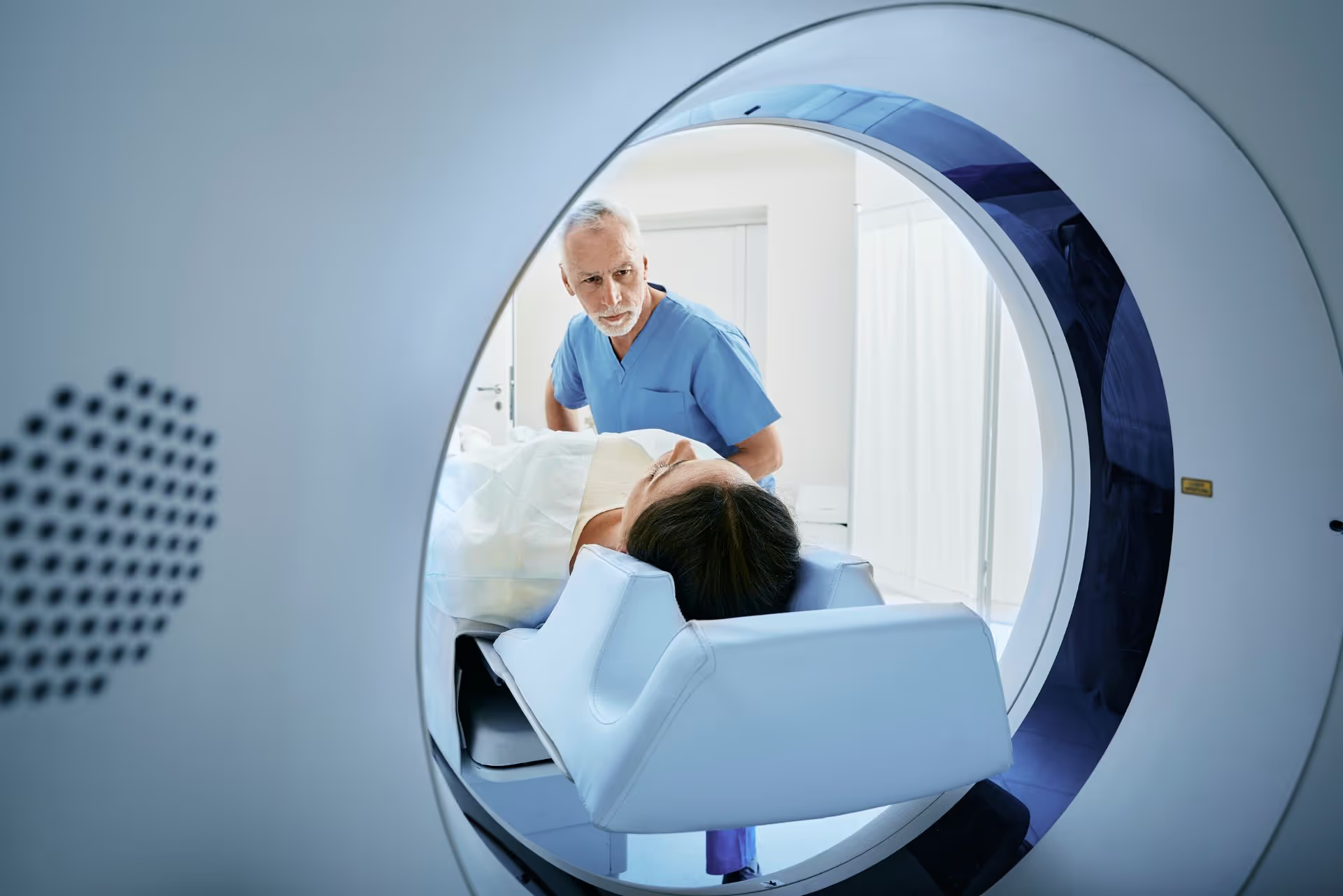
After the CT scan, the images will be examined by the radiologist who is responsible for producing a written report on their findings to send to your referring clinician. Our radiologists are all qualified doctors and specialise in specific body areas, giving you, and your referring clinician confidence in the accuracy of your report.
Research from a study at University College London called Re-Imagine has shown that MRI can detect prostate cancers in men with a normal PSA, which would otherwise not be diagnosed.The study found that a Prostate MRI offers the opportunity to identify significant prostate cancer in men whose PSA is normal for their age. Data from the study group showed that a high-quality biparametric MRI scan picked up significant cancer in 1 in 6 men. Some of these men had a PSA of less than 3ng/ml and would not have been eligible for further investigations under current NHS guidelines.
You can now Self Refer for an MRI scan for certain areas. Find out more by visiting ‘Private MRI Scan Without A Referral.
If you still require a referral to have a scan with us you will need a written referral from a healthcare professional. This can be your Consultant, GP, Physiotherapist or Osteopath. Once we have this we can arrange an appointment at your convenience.
If you already have a referral you can book an appointment for your diagnostic scan today.
If you do not have a referral but would like to be seen, please call our centre direct on 01293 534 043 and our team will discuss how to arrange a referral with you.
Yes, you can eat and drink as normal after a CT scan.If you have an injection of contrast during your examination, it is beneficial to drink plenty of water (2-3 extra glasses) after your examination to help flush out the contrast from your system.
.png)
.png)